What Custom Ornamental Iron Actually Means When a Shop Builds It Themselves
Welding, bending, rolling, hammering, forging, punching, shearing and pressing, all under one roof.
September 2, 2026 · 4 min read
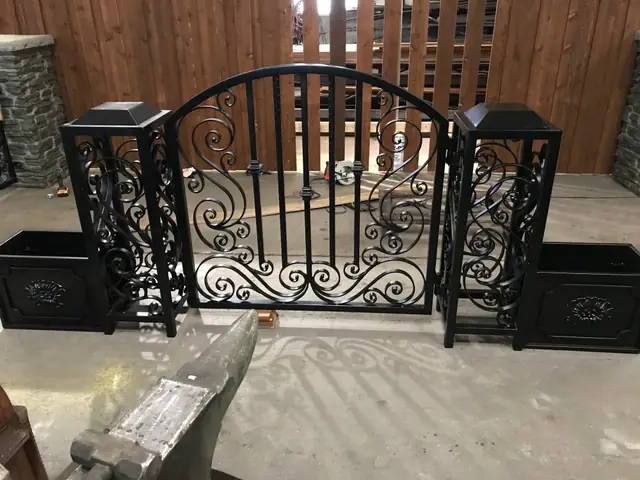
A lot of companies that sell iron gates and railings are not actually shops. They are dealers, ordering a catalog piece from somewhere else and installing it. Cook's Fence & Iron is the other kind. The company runs one of Oklahoma's most complete ornamental iron fabrication facilities, which means the piece that ends up on your property was made there, by people working the metal directly, not selected from a binder.
Eight ways to work the metal
Fabrication in that shop covers eight distinct operations: welding, bending, rolling, hammering, forging, punching, shearing and pressing. Each does something different to the metal. Welding joins pieces together. Bending and rolling shape a straight bar into a curve, an arch or a scroll. Punching and shearing cut and pierce steel cleanly. Pressing and hammering form and finish a piece by hand, the way a scroll gets its taper or a leaf gets its shape. A shop that can only weld is building boxes. A shop that can do all eight is building whatever the design actually calls for, which is the difference between a fence that looks like every other fence on the street and one that does not.
Old world technique, modern machinery
The phrase Cook's Fence & Iron uses for its own work is old-world iron techniques combined with modern machinery, and that is a literal description, not a slogan. Hand-forged wrought iron work, heating a bar and shaping it under hammer blows the way a blacksmith would have a century ago, still happens on pieces that call for it, a scroll, a finial, a decorative flourish that a machine cannot replicate with the same character. Alongside that, the shop uses modern equipment for the parts of the job where consistency and speed matter more than handwork, cutting, forming, and assembling components that need to match each other precisely across a long fence run or a matched pair of gates.
Designed before it's built
Design work happens before any metal gets touched. Cook's Fence & Iron uses AutoCAD detailing for custom projects, which means a design gets drawn and dimensioned properly before fabrication starts, not sketched on a pad and adjusted on the fly. For a straightforward residential gate that might be a light step in the process. For a large commercial job, a matched set of gates, or a piece with an unusual shape or mounting condition, that drawing is what keeps the finished piece fitting the opening it was measured for.
More than gates
What comes out of a shop with that range of capability is not limited to gates. Original iron gates and railings are the obvious output, but the same fabrication process produces custom fencing, iron furniture, mailboxes, Vent-A-Hood range hood products, signs, Juliet balconies and bridge railings. A Route 66 shield sign and a set of interlocking OU and OSU letterforms cut and welded in the same shop are the same skill set applied to a different brief, cutting steel cleanly, shaping it, and finishing it so it holds up outdoors for years. If you can describe it in steel, it is very likely something the shop has already built a version of for someone else.
Is your project a fit
That range matters for anyone trying to figure out whether their project is even the kind of thing an ornamental iron shop handles. A homeowner picturing a decorative gate for a courtyard, a property manager who needs a stairwell railing that meets fall protection requirements, and a business owner who wants a custom sign welded up for the building are all describing different projects, but they are all describing the same shop's daily work. The common thread is that none of it is off the shelf, and none of it starts from a mold or a die that was made for somebody else's building first.
Repairs and one-off pieces
Working with a shop that fabricates everything in house also changes how repairs and one-off pieces get handled later. A gate panel damaged in an accident, a railing section that needs to match an existing run built decades ago, or a single custom piece that would never justify a factory production run are all easier to solve when the same people who could build it from scratch can also match it. A dealer reselling a catalog product does not have that option once the catalog changes.
Cook's Fence & Iron has been fabricating in Oklahoma City since 1949, and the current team carries over 175 years of combined service between them, which is the kind of depth that shows up in the small decisions on a job, not just the big ones. If you have an iron project that does not fit neatly into a catalog, that is exactly the kind of call worth making. Free estimates are available at (405) 681-2301.
Cook's Fence & Iron Co Inc — (405) 681-2301
Call (405) 681-2301More articles
Cedar Fence on Steel Posts: Why It Holds Up in Oklahoma Wind
The wood decides how the fence looks. The post decides whether it survives an Oklahoma spring.
Swing, Cantilever or Rolling: Choosing the Right Driveway Gate
The gate that looks best in a photo is not always the one that will actually work on your driveway.